
Article: Vintage Pop Culture T-Shirts: Advertising, Art & Collector’s Guide
Vintage Pop Culture T-Shirts: Advertising, Art & Collector’s Guide

The Vintage Rare USA archive • Advertising, art, celebrity & humor
Vintage pop culture T-shirts preserve the images people recognized in everyday life: a soft-drink mascot, a commercial catchphrase, an artist’s drawing or a joke about the news. This illustrated guide studies ten pieces from the Vintage Rare USA sold archive, pairing each garment with its own label and copyright or design detail.
From Coca-Cola’s polar bear and Shaq’s Pepsi advertisement to Keith Haring, Einstein and an El Niño “World Tour,” the selection explores how familiar ideas became wearable graphics. These are archive references, not a promise that the pictured pieces are available. Browse current Pop Culture clothing for the live selection.
What belongs in a pop culture T-shirt collection?
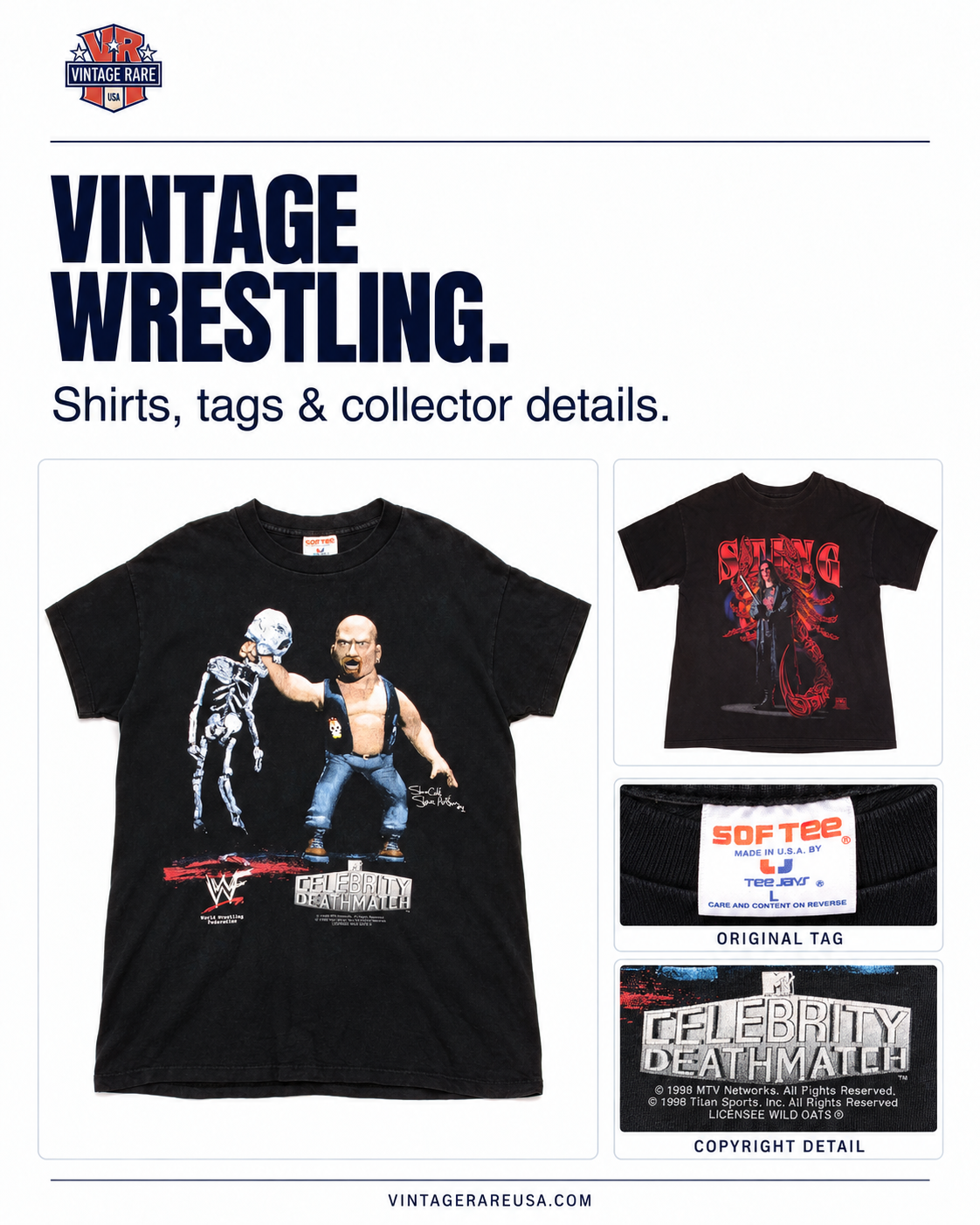
Here, the focus is advertising, public figures, art, corporate design and novelty humor. Film characters and wrestling have their own collecting traditions; this guide gives everyday brands and cultural references room to tell a different story. A household mascot can be as visually distinctive as a movie portrait, while a company shirt may hide its best artwork on the back.
Read the shirt, the label and the small print together
The garment establishes the complete design: color, front, back, sleeve details and print placement. The label can name the blank maker, size, fiber content and manufacturing location. The copyright or licensing line may identify a rights holder, licensee and printed year. These are complementary clues, not interchangeable facts.
A copyright year dates a rights notice, not necessarily the manufacture of the garment. A missing tag stays missing in this guide. When a photo does not show a readable copyright, the third panel presents the reverse or artwork detail instead. Click a photograph to inspect its original.
Coca-Cola: the polar bear as a pop-culture character


Tag reference: Coke woven label; separate care label shows Large and Made in USA.
Copyright / date evidence: 1995 The Coca-Cola Company.
The sunglasses, red visor and ice-blue water turn a drinks advertisement into a character portrait. On this navy shirt, the bear emerges among floating ice with a Coca-Cola bottle beside it. The contrast between the dark cotton and pale illustration makes the graphic readable from a distance, while the small copyright line rewards a closer look.
The red Coke neck label connects the garment branding to the front design. A separate care-label photograph records Large and Made in USA. The printed copyright reads 1995 The Coca-Cola Company; that is evidence about the design’s rights notice, rather than a certificate of the garment’s exact manufacturing year.
Coca-Cola’s own history of its animated polar bears places their television debut in 1993. That campaign history helps explain the character’s place in 1990s advertising. It does not mean every bear shirt is from 1993, or that every bear illustration was used in the same advertisement.
Collector’s detail: Compare the bear’s pose, accessories and surrounding scene—not just the brand name.
Shaq and Pepsi: a celebrity endorsement told front and back


Tag reference: 100% cotton; L; Made in Dominican Rep.
Copyright / date evidence: No readable dated copyright in the selected photographs.
This white tee brings a celebrity, a consumer brand and a familiar advertising exchange together. The front places Shaquille O’Neal opposite a child under a question about giving up Pepsi. The reverse supplies the emphatic answer. Seeing only the front would miss half the design.
The archive describes the piece as a 1990s shirt. Its photographed tag records 100% cotton, L and manufacture in the Dominican Republic. Those details should be retained as shown; neither an assumed American origin nor an invented print date improves the reference.
For a celebrity-advertising collection, the appeal is the crossover itself: this is a Shaq shirt whose subject is a commercial, rather than a team jersey or game photograph. Compare the image crop, blue border, front wording and back typography when identifying another example.
Collector’s detail: A slogan can be split between two sides. Save the complete front-and-back pairing.
Ben & Jerry’s Wavy Gravy: flavor history in tie-dye


Tag reference: No surviving neck tag is visible.
Copyright / date evidence: No readable dated copyright shown in this photo set.
The spiral tie-dye is part of this shirt’s identity. Yellow, pink, blue and purple radiate around the circular Ben & Jerry’s design, with Wavy Gravy named below. The effect links an ice-cream product to a broader visual language of music festivals and counterculture.
Ben & Jerry’s documents the flavor’s 1993 introduction. That date supplies useful subject history, but the shirt’s missing label prevents us from assigning a blank manufacturer from these photographs. The archive’s 1990s description remains a broad dating attribution, not a claim that this garment was printed in the launch year.
Compare the flavor name and illustration before treating two tie-dye Ben & Jerry’s tees as interchangeable. A general company logo, a particular flavor and a different character treatment can represent distinct designs. The reverse photograph also shows how the dye pattern continues across the garment.
Collector’s detail: Do not borrow a label from a different Ben & Jerry’s shirt to fill a gap in this one.
Mr. Bubble: household packaging becomes a ringer tee


Tag reference: Tee Jays; XL; Made in USA. Archive listing calls the piece Large.
Copyright / date evidence: 1995 Reckitt & Colman Inc.; manufactured under license by Coastal Concepts Inc., Vista, CA.
Mr. Bubble’s pink character, yellow crown and floating bubbles bring the packaging illustration onto a white ringer shirt. Dark neck and sleeve bands frame the design, giving it a different silhouette from a standard white crewneck. The garment construction is part of what makes this reference worth saving.
The fine print separates the rights holder from the manufacturer working under license. It identifies a 1995 Reckitt & Colman notice and Coastal Concepts in Vista, California. The neck label, meanwhile, names Tee Jays. These three names describe different roles; they should not be collapsed into a single maker attribution.
The photographed tag reads XL, while the archive title calls the garment Large. We preserve that difference rather than silently correcting the evidence. For wearable fit, measurements matter more than either label alone. The archive also includes condition photographs of marks, useful when comparing this example with a cleaner one.
Collector’s detail: Record the blank label, rights holder and licensee separately; each answers a different question.
Energizer Bunny: mascot artwork and a bold reverse slogan


Tag reference: 100% cotton; Medium; Made in USA. Archive title calls the piece Small.
Copyright / date evidence: 1991 Eveready Battery Company, Inc.
The pink rabbit, sunglasses and drum give this black tee a recognizable advertising character without needing a large headline. The reverse changes the visual rhythm: a tall block of pink-and-blue typography carries the battery slogan. A small front mascot and a large back statement create two different views of the same campaign identity.
The close-up clearly records a 1991 Eveready Battery Company copyright. The care label says Medium, 100% cotton and Made in USA, although the archive title says Small. That discrepancy is a practical reminder to read the garment itself and check actual measurements.
When comparing examples, look at the drum logo, rabbit pose and the proportions of the reverse typography. The date beneath the design is useful evidence, but does not independently establish when the blank was sewn or prove that every similar-looking tee shares the same production history.
Collector’s detail: Photograph the copyright at readable scale; a tiny line beneath a mascot can carry the best attribution.
Keith Haring’s Statue of Liberty: artwork date versus garment date


Tag reference: Valley Apparel Inc.; Large; 100% cotton; Made in USA. Archive listing calls the piece Medium.
Copyright / date evidence: Printed K. Haring mark and TM; no readable dated copyright in the selected photographs.
The peach garment provides a warm background for green Liberty, a pink rectangle and yellow raised hands. Thick black outlines unify the composition. This is an art-led reference: its interest lies in the specific drawing, color arrangement and printed mark as much as in the name associated with it.
The Keith Haring Foundation’s account of his work with children describes a Statue of Liberty banner made with CityKids for the 1986 centennial. That is relevant context for Haring’s Liberty imagery. It does not establish this shirt as an event-issued garment or prove a 1986 manufacture date.
Our archive title attributes the shirt to 1986 and calls it Medium. The photographed Valley Apparel label actually reads Large, 100% cotton and Made in USA; the artwork close-up shows a printed K. Haring mark but no clearly readable year. Keeping those observations separate makes the guide more useful than repeating the listing title as unquestioned fact.
Collector’s detail: A printed artist mark is not a hand-signed autograph, and an artwork’s date does not automatically date the shirt.
Albert Einstein: the science portrait as a graphic tee


Tag reference: Cotton Expressions Limited; M; 100% cotton; Made in Mexico of U.S.A. fabric.
Copyright / date evidence: 1993 Cotton Expressions, Ltd.
Einstein’s face emerges from a field of white speckles and points of light, giving the portrait a cosmic treatment. Rather than relying on a bright logo, the design uses the black garment as negative space. The face becomes legible as you step back, while the close-up reveals the texture of the print.
The label identifies Cotton Expressions Limited, size M and 100% cotton, with the manufacturing wording Made in Mexico of U.S.A. fabric. The print close-up carries a 1993 Cotton Expressions credit and a signature-style artist mark. We retain the readable company credit without guessing at the signature.
This example shows how pop-culture collecting can include science and public figures alongside advertising mascots. Compare the exact portrait treatment, caption placement and print credit: two shirts depicting Einstein may have little in common beyond their subject.
Collector’s detail: Keep “Made in Mexico of U.S.A. fabric” intact; it is not the same statement as Made in USA.
Xerox: corporate graphics with an unexpected back print


Tag reference: Fruit of the Loom BEST; L; 50% cotton / 50% polyester; assembled in Dominican Republic of U.S.A. fabric.
Copyright / date evidence: No readable dated copyright in the selected photographs.
From the front, the small Xerox mark looks like a restrained company shirt. Turn it around and the design becomes much more expressive: a profile, intersecting colored lines, shapes and large innovation messaging fill the back. The contrast is precisely what makes corporate promotional clothing worth looking through carefully.
The label is Fruit of the Loom BEST, size L, in a 50/50 cotton–polyester blend. It specifies assembly in the Dominican Republic using U.S.A. fabric. There is no clearly readable dated copyright in the selected images, so the archive’s 1990s description is not narrowed to a particular year.
The graphics suggest a corporate promotional context, but the photographs alone do not identify a particular conference, employee event or giveaway. That distinction matters: an appealing story should follow the evidence. Here, the documented strength is the front-and-back design pairing.
Collector’s detail: Check the back of even the simplest company-logo tee; the strongest artwork may be there.
Big Dogs: a visual joke you can read twice


Tag reference: Big Dogs yellow woven label; XL.
Copyright / date evidence: Big Dogs 1992.
This grey tee turns a familiar phrase about having the floor into a literal scene. An oversized dog holds planks while people gather below. The speech bubble, illustration and brand mark work together, making the shirt more specific than a generic mascot logo.
The yellow neck label shows Big Dogs and XL. A dedicated print close-up records Big Dogs 1992. These selected images all belong to the grey floor-joke design; other photographs attached to the archive listing show a different blue bowling shirt and are deliberately excluded from this reference.
For humor tees, identify the complete joke and its visual setup. A phrase may recur across different drawings, and a brand may reuse its mascot across many subjects. Saving only the brand name loses the detail that makes a particular shirt memorable.
Collector’s detail: A listing can contain mixed photo sets. Match garment color, artwork and tag before combining images.
El Niño World Tour: current events dressed as tour merchandise


Tag reference: TNT by Trau & Loevner; Adult-L.
Copyright / date evidence: No readable dated copyright in the selected photographs.
The globe, sweeping arrows and World Tour wording borrow the visual language of concert merchandise. The back extends the joke with a list of cities crossed by a Rained Out stamp. It is a weather reference presented as a touring act, and the two sides need to be read together.
The photographed label identifies TNT by Trau & Loevner and Adult-L. Although the archive title also mentions La Niña, the visible front print names El Niño. We describe the garment shown rather than adding words from a broader listing title.
The archive places this shirt in the 1990s, but the selected photographs do not supply a readable printed year. Without further documentation, it would be too specific to assign it to one particular weather season. Its value as a reference comes from the parody format, the complete joke and the surviving label.
Collector’s detail: Tour-style typography does not necessarily mean a music shirt. Read the subject and reverse before categorizing it.
At-a-glance label and copyright reference
Printed years below are visible rights notices, not independently verified manufacturing dates.
| Archive piece | Label evidence | Copyright / date evidence |
|---|---|---|
| Coca-Cola | Coke woven label; separate care label shows Large and Made in USA. | 1995 The Coca-Cola Company. |
| Shaq and Pepsi | 100% cotton; L; Made in Dominican Rep. | No readable dated copyright in the selected photographs. |
| Ben & Jerry’s Wavy Gravy | No surviving neck tag is visible. | No readable dated copyright shown in this photo set. |
| Mr. Bubble | Tee Jays; XL; Made in USA. Archive listing calls the piece Large. | 1995 Reckitt & Colman Inc.; manufactured under license by Coastal Concepts Inc., Vista, CA. |
| Energizer Bunny | 100% cotton; Medium; Made in USA. Archive title calls the piece Small. | 1991 Eveready Battery Company, Inc. |
| Keith Haring’s Statue of Liberty | Valley Apparel Inc.; Large; 100% cotton; Made in USA. Archive listing calls the piece Medium. | Printed K. Haring mark and TM; no readable dated copyright in the selected photographs. |
| Albert Einstein | Cotton Expressions Limited; M; 100% cotton; Made in Mexico of U.S.A. fabric. | 1993 Cotton Expressions, Ltd. |
| Xerox | Fruit of the Loom BEST; L; 50% cotton / 50% polyester; assembled in Dominican Republic of U.S.A. fabric. | No readable dated copyright in the selected photographs. |
| Big Dogs | Big Dogs yellow woven label; XL. | Big Dogs 1992. |
| El Niño World Tour | TNT by Trau & Loevner; Adult-L. | No readable dated copyright in the selected photographs. |
How to build a collection with a point of view
Collect a subject, then compare different treatments
A mascot collection could place Coca-Cola’s bear beside Mr. Bubble and the Energizer Bunny. An art-and-portrait collection could compare Haring’s flat colors with Einstein’s speckled monochrome face. A humor collection might pair Big Dogs with El Niño. Choosing a theme helps make each purchase purposeful without requiring every shirt to look alike.
Keep promotional context separate from provenance
A brand logo is evidence of the subject, not proof that a shirt was an employee uniform, a limited giveaway or a first-release campaign item. Look for dated event wording, original packaging or other documentation before making a more specific claim. The same care applies to printed artist signatures and celebrity images.
Assess the whole garment
Examine the collar, seams, fabric and print together. Single-stitch sleeves can be useful to document, but do not authenticate a shirt on their own. Compare chest width and length with a garment you wear, especially when a listing size differs from the photographed tag. Inspect marks and repairs around faces, lettering and the main graphic; their placement matters as much as their size.
Keep a photographic record
Save the complete front and back, both sides of the label, readable copyright, measurements and condition details. If a photo set includes more than one shirt, separate the records before comparing them. Use the actual wording on a manufacturing label rather than shortening it into a different claim.
What affects collectibility and value?
Subject, design, size, condition, print completeness and documented provenance all affect how collectors compare pieces. An unusual graphic is not automatically rare, and an archive listing price is not proof of a completed sale. For a useful comparison, look for completed sales of the same design and account for differences in fit, fading, damage and missing labels.
These ten selections were chosen for their artwork and the details readers can study. They are not ranked by price. A modest corporate tee with an excellent reverse print can teach as much about graphic culture as a more familiar celebrity design.
Frequently asked questions
Does the copyright year tell me when a vintage shirt was made?
Not by itself. It records a year associated with the printed rights notice. Compare it with the label, construction and any independent documentation. The Haring reference also shows why an artwork date and a garment date should be kept separate.
Can a tagless shirt still be worth collecting?
Yes, but it provides less information about the blank. The Wavy Gravy tee preserves its flavor graphic and tie-dye pattern even though no neck tag survives in the photographs. Describe the missing information openly and use measurements for fit.
Are all vintage advertising shirts made in the USA?
No. These examples include Dominican Republic manufacture, Mexico manufacture using U.S.A. fabric, and USA-made labels. Record the wording as photographed rather than treating one country as an automatic authenticity test.
Does a licensing line prove the whole shirt is authentic?
A licensing line is useful evidence about the print, but no single feature settles every question. Assess the garment, tag, printing and available provenance together. A familiar logo can appear on original merchandise, later reissues and reproductions.
What if the tag and listing size disagree?
Keep both facts visible and rely on current measurements for fit. The Mr. Bubble, Energizer and Haring examples demonstrate why a title alone should not be used as a label transcription.
Are these exact shirts available?
The pictured garments were selected from our sold archive. Visit the Pop Culture collection for current pieces, or browse New Arrivals. Check each listing’s availability, measurements and condition before purchasing.
Continue exploring
Browse our Expert Vintage Clothing Guides for more label, construction and collecting references. For other graphic subjects, explore Movie, TV & Video Game T-shirts and Wrestling T-shirts.

Leave a comment
This site is protected by hCaptcha and the hCaptcha Privacy Policy and Terms of Service apply.