
Vintage Ralph Lauren Sweaters & Quarter-Zips: Buying Guide
Original photography & buying reference by Vintage Rare USA
Reviewed October 15, 2026. This guide uses matching garment and label photographs from our catalog and archive. The cable-knit example is explicitly included as a modern-label comparison, not as evidence of 1990s production.
© 2026 Vintage Rare USA. Original text, photography and collage layouts are protected by copyright unless otherwise credited. Please link to this guide when referencing our work.
Buying a vintage Ralph Lauren sweater takes more than recognizing a Pony or choosing your usual size. A cotton quarter-zip, a cable-knit crewneck and a wool cardigan can have very different weight, stretch, care requirements and fit. Older clothing can also change shape through washing, storage and wear.
This guide focuses on choosing a wearable piece: identifying the construction, checking materials, comparing measurements and reading the label information that the photographs actually support. For the wider brand history, see our Ralph Lauren tags and dating guide.
Browse Polo Ralph Lauren clothing and knitwear →
Sweater, sweatshirt or quarter-zip: what are you buying?
“Quarter-zip” describes a short front opening, not a fiber or one particular fabric. A quarter-zip can be a knitted sweater, a sweatshirt or a fleece layer. Online listings sometimes use these terms loosely, so examine the material label and close-up photographs before deciding what it will feel like.
| Style | Useful details | Check before buying |
|---|---|---|
| Fine or textured quarter-zip | Stand collar, short zipper and usually ribbed trim | Fabric content, collar shape, zipper and sleeve length |
| Cable-knit crewneck | Raised cable patterns with a round neckline | Snags, distorted cables, fiber label and body length |
| Crewneck or V-neck sweater | Simple silhouette suited to layering | Neckline recovery, shoulder fit and knit thinning |
| Cardigan | Open or buttoned front | Placket shape, buttonholes and matching buttons |
| Graphic or Polo Bear knit | A design knitted into the fabric, embroidered or otherwise applied | Construction of the motif, full labels and evidence for any age claim |
| Fleece or sweatshirt quarter-zip | A different surface and interior from many traditional sweater knits | Interior fabric, pilling, cuffs and the stated material |
A cable pattern is not a fiber identification. Ralph Lauren makes cable-knit sweaters in different materials, including current cotton styles. The same broad design can therefore appear across eras and fabrics. Reference: Ralph Lauren’s cable-knit cotton crewneck.
Read a quarter-zip through its matching labels

The olive-green example combines a stand collar, short zipper and red Pony embroidery. Its neck label reads Polo by Ralph Lauren and XL; the accompanying content label states Made in Vietnam, 100% cotton, exclusive of decoration.
The separate care photograph is just as useful. It specifies cold machine washing separately, mild detergent, no bleach, low tumble drying and no dry cleaning. Those directions belong to this garment. They should not be copied onto a wool or cashmere sweater simply because the brand or silhouette looks similar.
These photographs establish visible label wording, construction and care instructions. They do not, by themselves, establish a precise production year. That distinction is useful when comparing an older-looking quarter-zip with a seller’s decade estimate.
What to examine on a quarter-zip
- Collar: look for stretching, uneven edges and wear where the zipper meets the neckline.
- Zipper: inspect the pull and the fabric tape. Ask whether the closure runs smoothly without separating.
- Cuffs and hem: compare their shape with the body. Tight trim, stretched ribbing or a shortened body can change the fit.
- Underarms: inspect for thinning, repairs and seam stress, especially in close-fitting knits.
- Inside surface: use it to understand the fabric rather than relying on “sweater” or “sweatshirt” in the title.
A classic cable knit can be modern: look for the whole label

Modern-label comparison: this brown cable-knit example has a blue-and-yellow Polo Ralph Lauren label, a size M tab and a yellow smartphone/QR tag. Its traditional design and familiar Pony do not make it a 1990s sweater.
Ralph Lauren announced the rollout of Digital Product IDs on November 1, 2019, starting with Polo products. A matching original digital-ID label is therefore a modern-production clue, not evidence of an earlier vintage decade. The precise year still requires further product information; the QR tag alone should not be treated as conclusive authentication. Source: Ralph Lauren’s Digital Product Identities announcement.
The absence of a QR tag does not prove age either. Labels can be missing, and the rollout was phased. Compare every available label and the full garment, and keep “pre-owned,” “vintage-inspired” and “vintage” separate when assessing a listing.
For the photographed brown example, the visible neck label does not establish the fiber content. Its texture and color are not enough to call it wool or cashmere. Ask for the fabric-content label before making that decision.
Materials: choose for your wardrobe and the actual care label
Cotton: useful when you prefer a sweater without animal fibers. Weight and knit density still matter; two cotton sweaters can feel quite different. Look for distortion at the shoulders and hem, and check the item’s own washing instructions.
Wool: assess the stated composition, thickness and intended use. Examine for holes, thinning and a dense, stiff or shrunken appearance. A small-looking sweater with oddly short sleeves may need closer inspection before you assume it is simply a slim cut.
Cashmere: buy based on a legible fiber label and condition. Softness alone is not a reliable identification method. Look closely at high-friction areas and ask about repairs or thinning rather than treating surface pilling as the only condition issue.
Blends: read the full percentages. An item may combine cotton with another fiber, or wool with synthetics. Do not simplify a blend to the most desirable ingredient when comparing listings.
How vintage Ralph Lauren sweaters should fit
Start with a sweater that already fits you well in the way you intend to wear the new piece. Lay it flat without stretching it. Compare the chest, body length and sleeves using the same measurement points as the seller.
- Pit to pit: measure straight across the body under the arms, with the knit relaxed. Do not compare a stretched measurement with an unstretched one.
- Body length: confirm whether the measurement begins at the high shoulder or back neckline. Include the hem consistently.
- Sleeves: check the stated starting point. Shoulder-to-cuff, underarm-to-cuff and center-back measurements are not interchangeable.
- Shoulders: note dropped or raglan construction before interpreting a wide shoulder measurement.
- Hem and collar: consider whether they gather, stretch or sit loosely, particularly if you plan to wear a shirt underneath.
Do not automatically size down because a listing says “1990s” or size up because it says “vintage.” The actual garment may have a relaxed original cut, a different intended wearer or changes from previous care. Photographs showing a sweater stretched over a hanger can also mislead; flat measurements are more useful.
For a gift, discreetly compare a sweater the recipient already likes. That gives a more reliable reference than their usual T-shirt size. If you cannot obtain useful measurements, a size-dependent vintage gift carries more uncertainty.
Condition checks that matter beyond pilling
Look at the elbows, underarms, cuff ends, neckline and lower front. Ask for close-ups of any repaired areas. On a cable knit, trace the raised pattern: pulled loops, broken yarn and compressed sections can be easier to see there than in a distant front photograph.
Check whether the garment hangs evenly when laid flat. A twisted body, markedly uneven sleeves or a wavy cardigan placket may indicate distortion. Some irregularity can be part of construction, so ask for measurements and additional views instead of diagnosing the cause from one picture.
For holes, distinguish a small stable repair from active unraveling or widespread damage. For pilling, inspect whether the fabric beneath remains sound. Do not assume that aggressive shaving will restore a thin or fragile knit.
Odor, stiffness and the feel of the fabric are difficult to judge online. A specific question about those points is more useful than asking whether a sweater is simply “good quality.”
Care and storage: follow the garment, not the category
Read the original care label before cleaning. The cotton quarter-zip shown above explicitly allows a routine that would be inappropriate for some other sweaters. If the label is missing, confirm the fiber and construction before treatment; an experienced knitwear cleaner can help with fragile or uncertain pieces.
For cashmere, Ralph Lauren recommends gentle handling, flat drying and folded storage. Its dedicated care guide cautions against wringing and direct heat and makes machine washing conditional on the care label permitting it. Apply those principles to the correct material rather than treating every Polo sweater alike. Reference: Ralph Lauren’s cashmere sweater care guide.
Store knitwear clean and fully dry. Support heavy sweaters when moving them, and avoid leaving them suspended in a way that pulls at the shoulders. Check stored pieces periodically rather than waiting until the next season to discover a problem.
Simple ways to wear Ralph Lauren knitwear
A plain quarter-zip layers easily over a T-shirt or an Oxford shirt; check that the collar closes comfortably if you intend to wear it zipped. A cable-knit crewneck can provide texture with straight-leg jeans or chinos. Keep the rest of an outfit simple when the sweater has a large graphic or strong pattern.
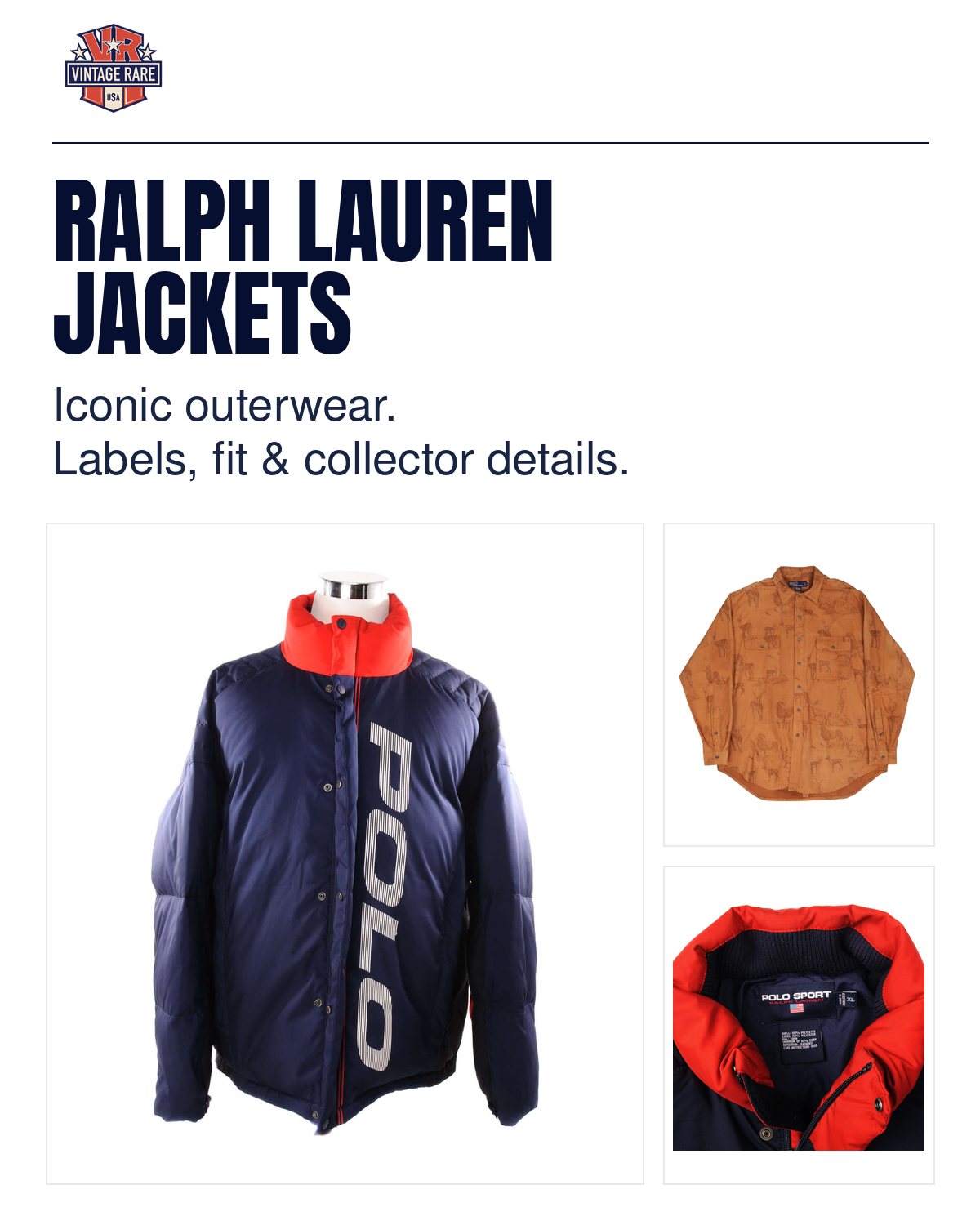
When adding a jacket, allow enough room for both layers to move. A heavy knit under a close-fitting sleeve can feel restrictive even when both garments fit comfortably on their own. Explore our Ralph Lauren jacket collection with the intended sweater’s thickness in mind.
Frequently asked questions
Is every Ralph Lauren quarter-zip a sweater?
No. Quarter-zip describes the opening. The garment may be traditional knitwear, sweatshirt fabric or fleece; check the construction and content label.
Does a blue Polo label mean a sweater is vintage?
No. Label color alone is not a reliable date. The illustrated cable knit has traditional branding alongside a modern digital-ID tag.
Can I identify cashmere from a photograph?
Not reliably. Read the fiber-content label and consider condition. A soft-looking surface or cable pattern does not establish cashmere content.
Do vintage Ralph Lauren sweaters run large?
Some have a relaxed cut, but there is no dependable rule for every era, line and construction. Compare the actual flat measurements.
Can all Polo sweaters be machine washed?
No. Follow the care label on the specific sweater. The cotton example’s instructions do not apply automatically to wool, cashmere or other blends.
Shop with the details in view
Explore Polo Ralph Lauren clothing at Vintage Rare USA and our Ralph Lauren sweatshirt and quarter-zip selection. Use the individual photographs, measurements and condition description to decide whether a piece suits you.
The photographs in this guide are reference examples, not a promise of availability or a dating certificate. The modern-label comparison is included to demonstrate why a familiar design must be evaluated alongside the actual labels.
© 2026 Vintage Rare USA. Original photographs, written material and collage layouts may not be reproduced without permission except as permitted by law. Attribution and a link to this guide are welcomed. See our Copyright & Image Usage Policy.

Leave a comment
This site is protected by hCaptcha and the hCaptcha Privacy Policy and Terms of Service apply.